
The universe speaks

Skip

I am the universe. For more thousands of years than anyone has counted, I have been watching this human race.

Aapki Gaatha
More
Start my book

India's first digital book for ordinary lives

What is not written, fades.

While you have been here, 0 lives ended somewhere · almost none of them written down

Every life is a book, and almost none of them get written. Kings hired chroniclers, film stars get biographies. Everyone else scatters exactly like this. Aapki Gaatha turns an ordinary life into a book that cannot scatter.

Speak it. It is written for you. Your first page in thirty seconds.

Made in India · Free to begin. No writing skill needed. Private until you decide.

More
The Gaatha ofRamesh Chandra Verma1954 — 2025

The only place a name does not fade.

Start my book

How it works

Three screens. That is the whole product.

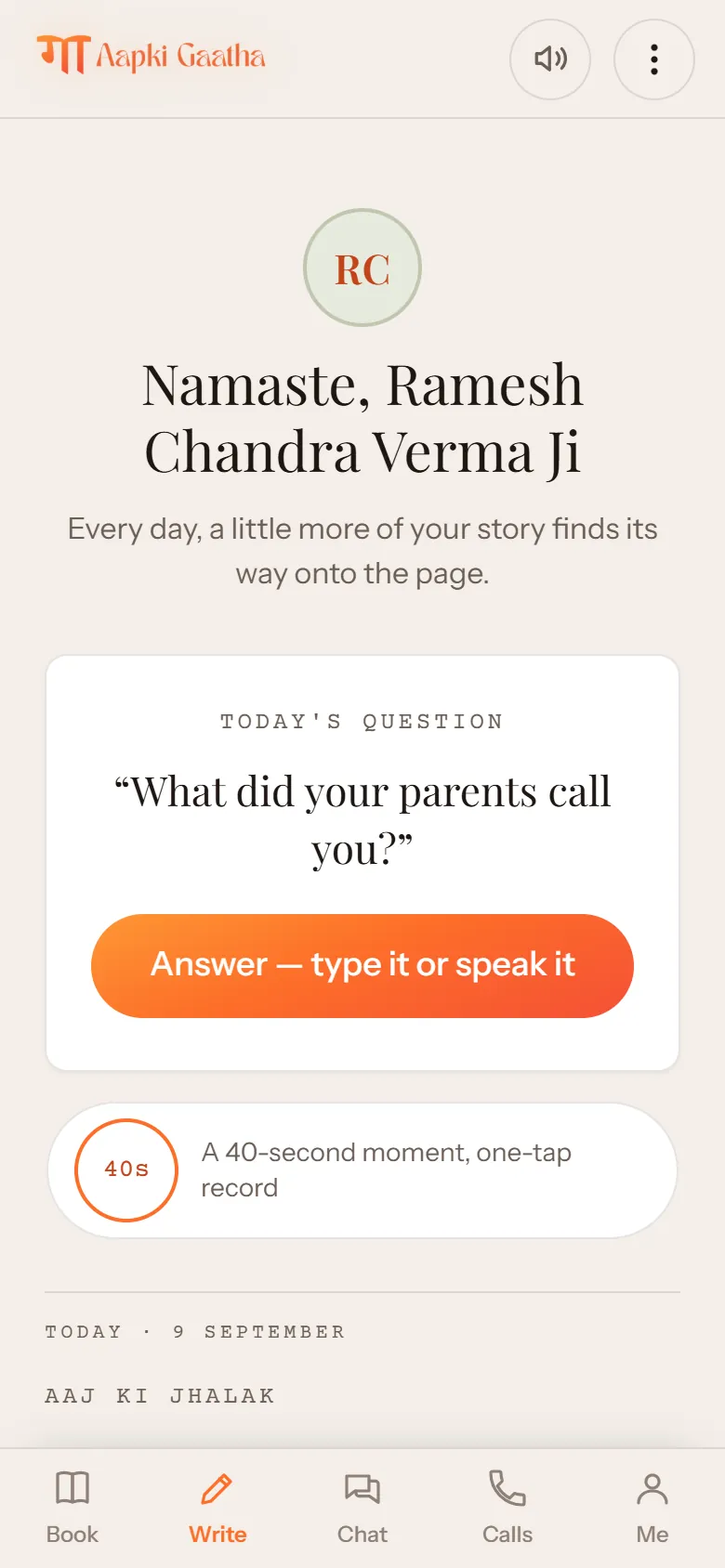
The app asks a question. Somebody answers it out loud, in their own language. By morning it is a page in a book — and the words they actually said are kept underneath it, one tap away, for as long as the book exists.

  1. One question a day, in Hindi or English. Skip it, shuffle it, or answer something else entirely. Sixty questions to begin with, then the ones the family asks.
    1

    It asks

    One question a day, in Hindi or English. Skip it, shuffle it, or answer something else entirely. Sixty questions to begin with, then the ones the family asks.

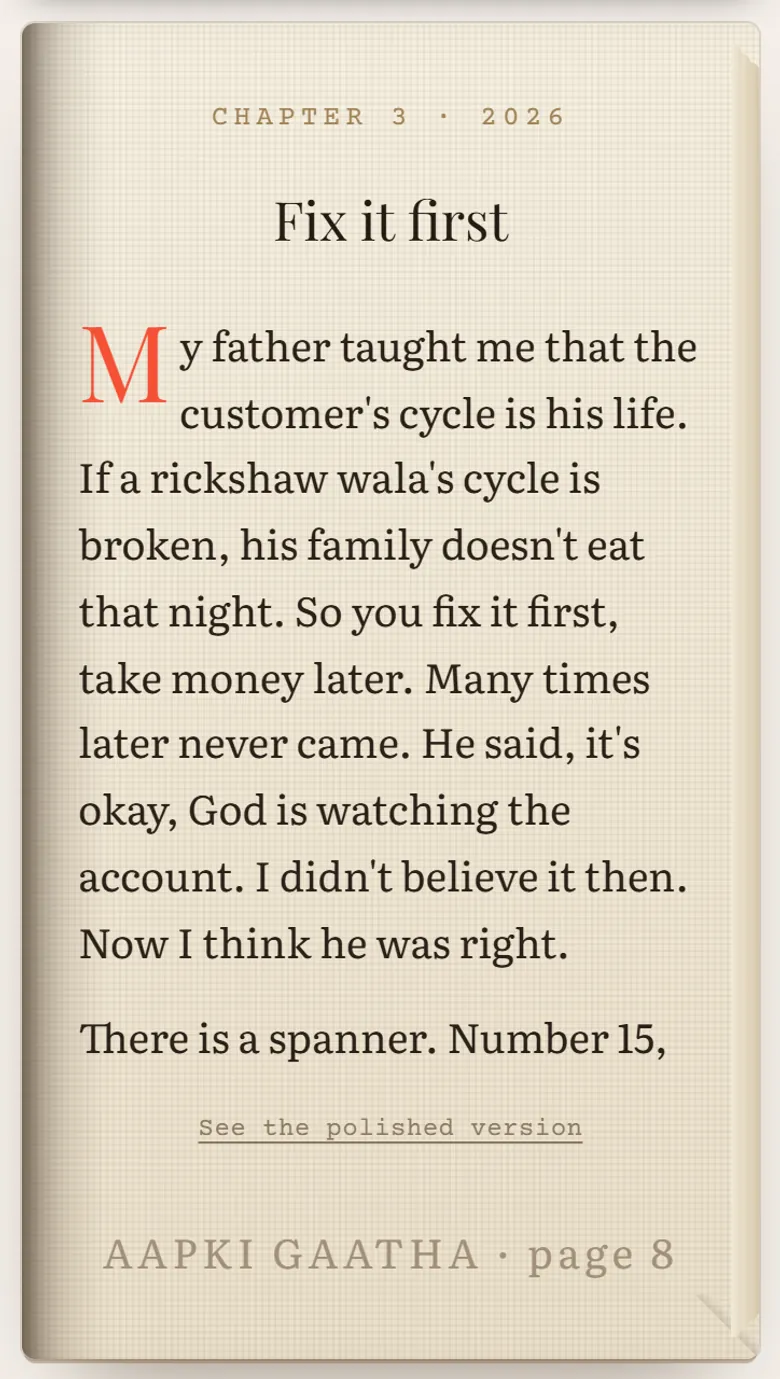
  2. The answer is spoken, not typed, and this is the transcript — exactly as it was said, sentence for sentence. Nothing spoken is thrown away.
    2

    They speak

    The answer is spoken, not typed, and this is the transcript — exactly as it was said, sentence for sentence. Nothing spoken is thrown away.

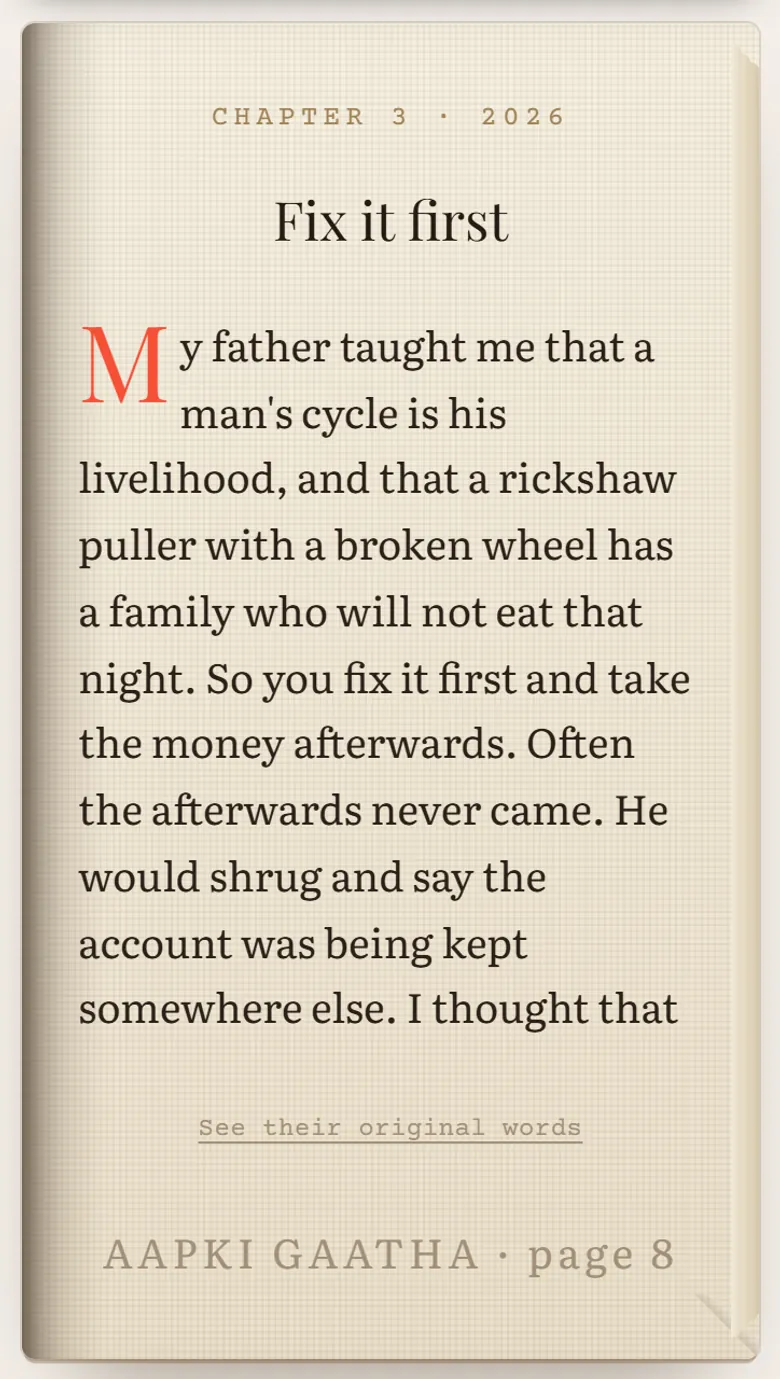
  3. The same answer, set as a chapter: the same facts, the same order, punctuated and paragraphed. Nothing is invented. “See their original words” turns the page back to the one before it.
    3

    It becomes a page

    The same answer, set as a chapter: the same facts, the same order, punctuated and paragraphed. Nothing is invented. “See their original words” turns the page back to the one before it.

Every picture on this page is a photograph of the working app, taken from a running build. None of them is an illustration.

The idea

Everywhere else, what you do is lost. Here, it becomes your book.

A WhatsApp chat scrolls away. A call ends. A photo sinks under nine thousand others. A story told at dinner is gone by Monday. In Aapki Gaatha you do the same things you already do, talk, call, send a photo, answer a grandchild, and every one of them writes itself into a book, in your own voice.

Everywhere elseHere
A chat with the familya page, in your voice, with the date
A phone call with your sonwritten into both your books
A photo sent on WhatsAppa plate between the chapters, captioned
A story told at the dinner tablechapter four
The sky the day you were borna page about the day you arrived

jo bhi karoge, kitaab me likha jaayega

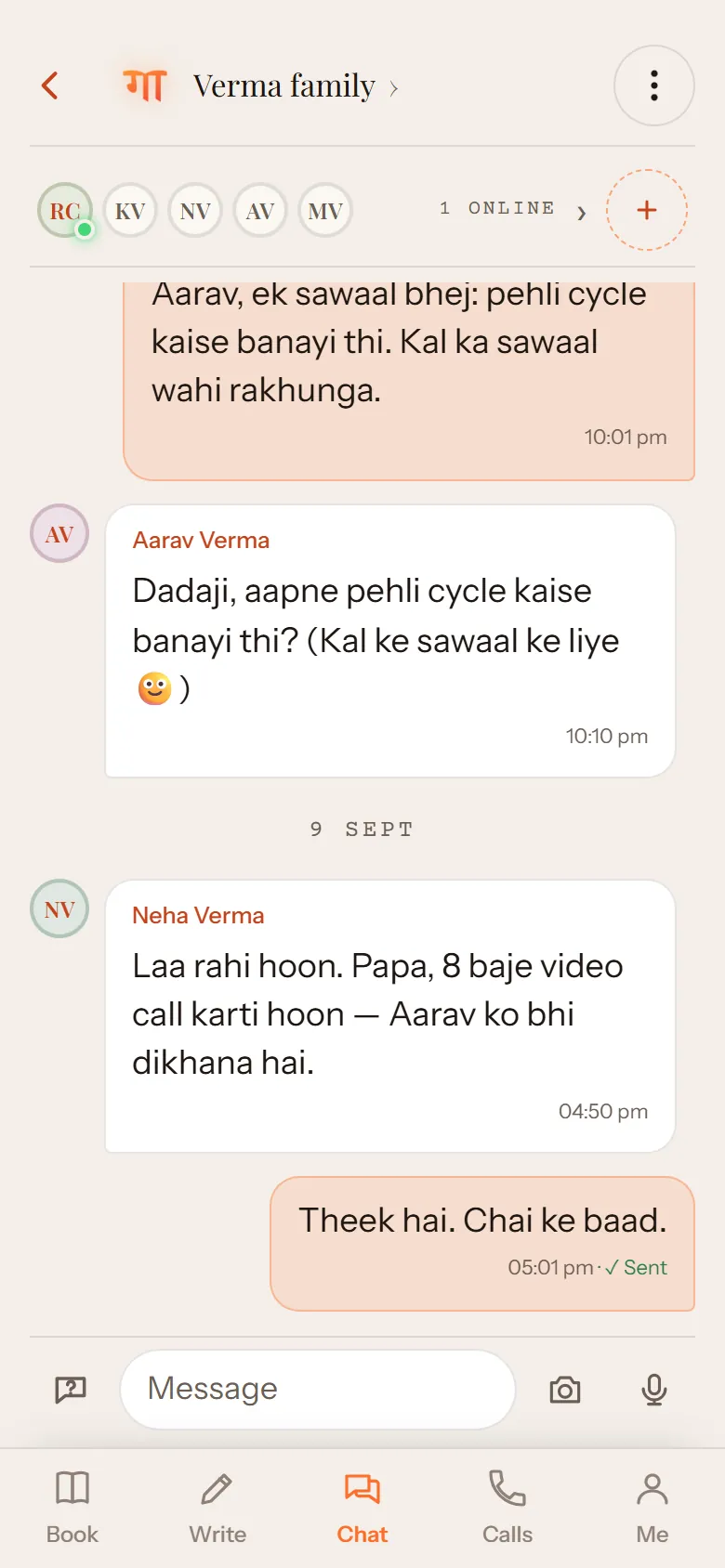
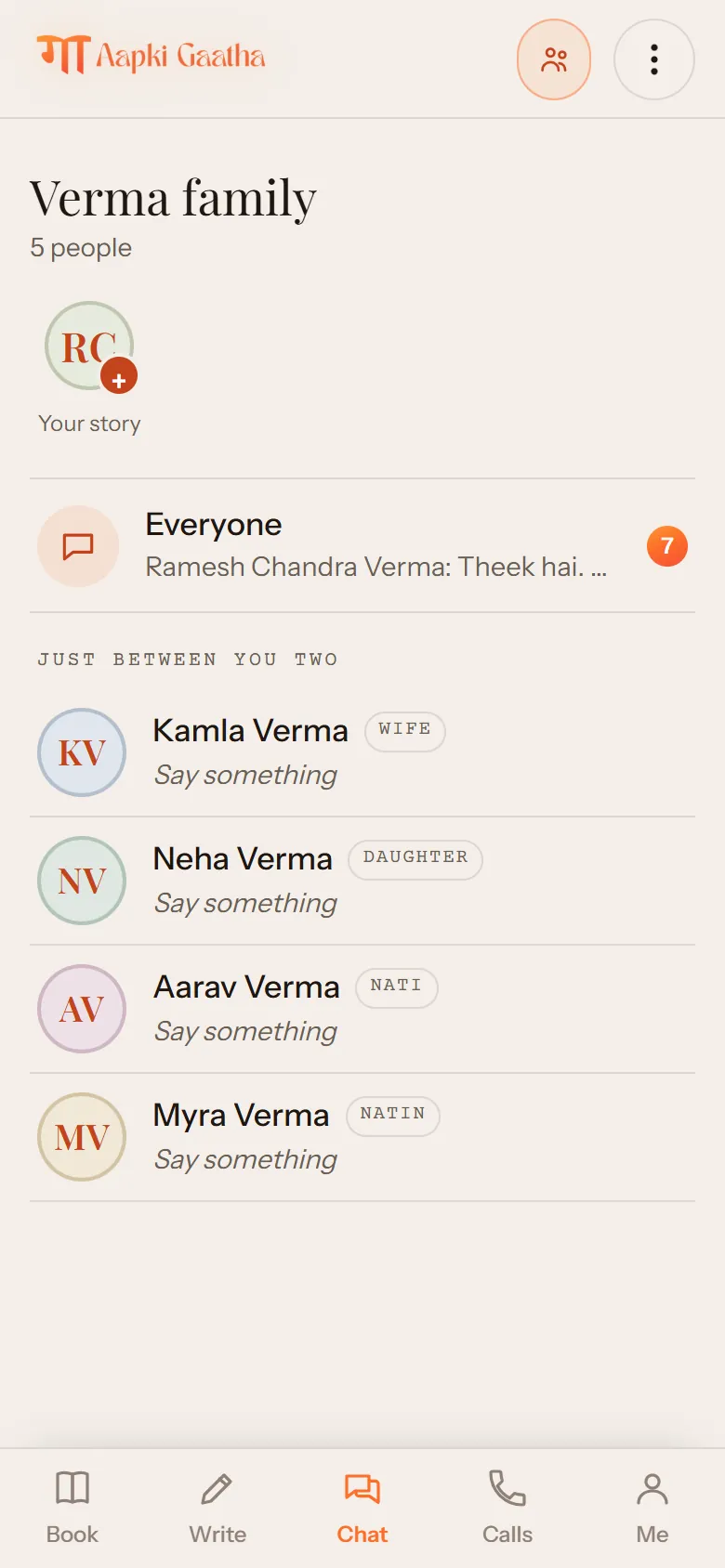
The Verma family’s room: Neha, Kamla, Aarav and Myra talking, in Hindi and English
The family roomEveryone in one room, and one line per person for the two of you. It looks like the app the family already uses — except that a question asked here becomes tomorrow’s page in somebody’s book, a voice note over twelve words goes into the book on its own, and a photo is one tap from being a plate between the chapters.
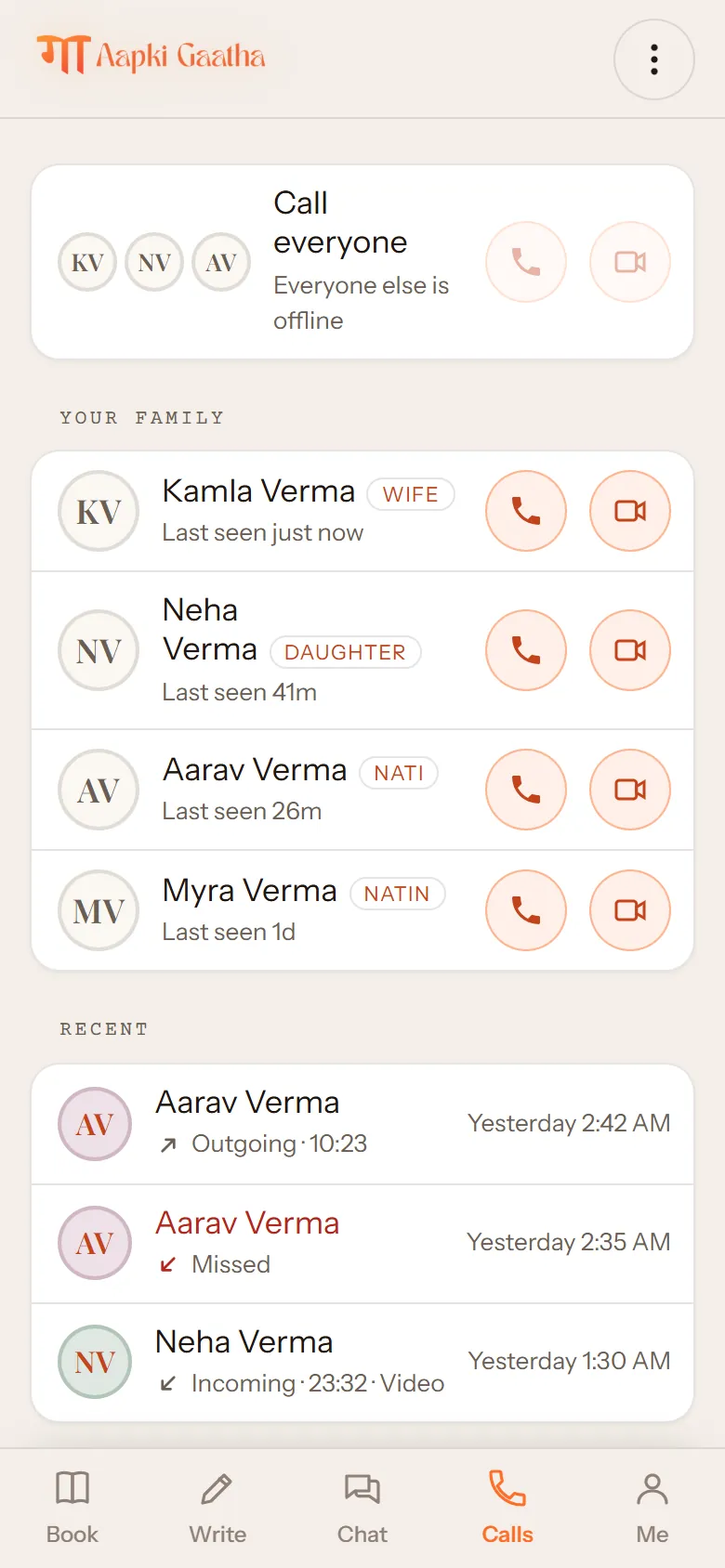
The calls screen: the family, each named by their relationship, and the register of recent calls
Calls that write themselvesVoice or video, up to four people, from inside the app. When the call ends, what was said is transcribed into each person’s book — the conversation a phone call has always thrown away.

Everything it does

Do what you already do. The book writes itself.

Every feature below has the same job: to catch something that would have been lost, and put it on a page.

१

Speak, and it is written

bolo, likha ho jaayega

The home screen: today’s question, and the microphone to answer it out loud
२

Keep what would be lost

jo bikhar jaata, ab rehta hai

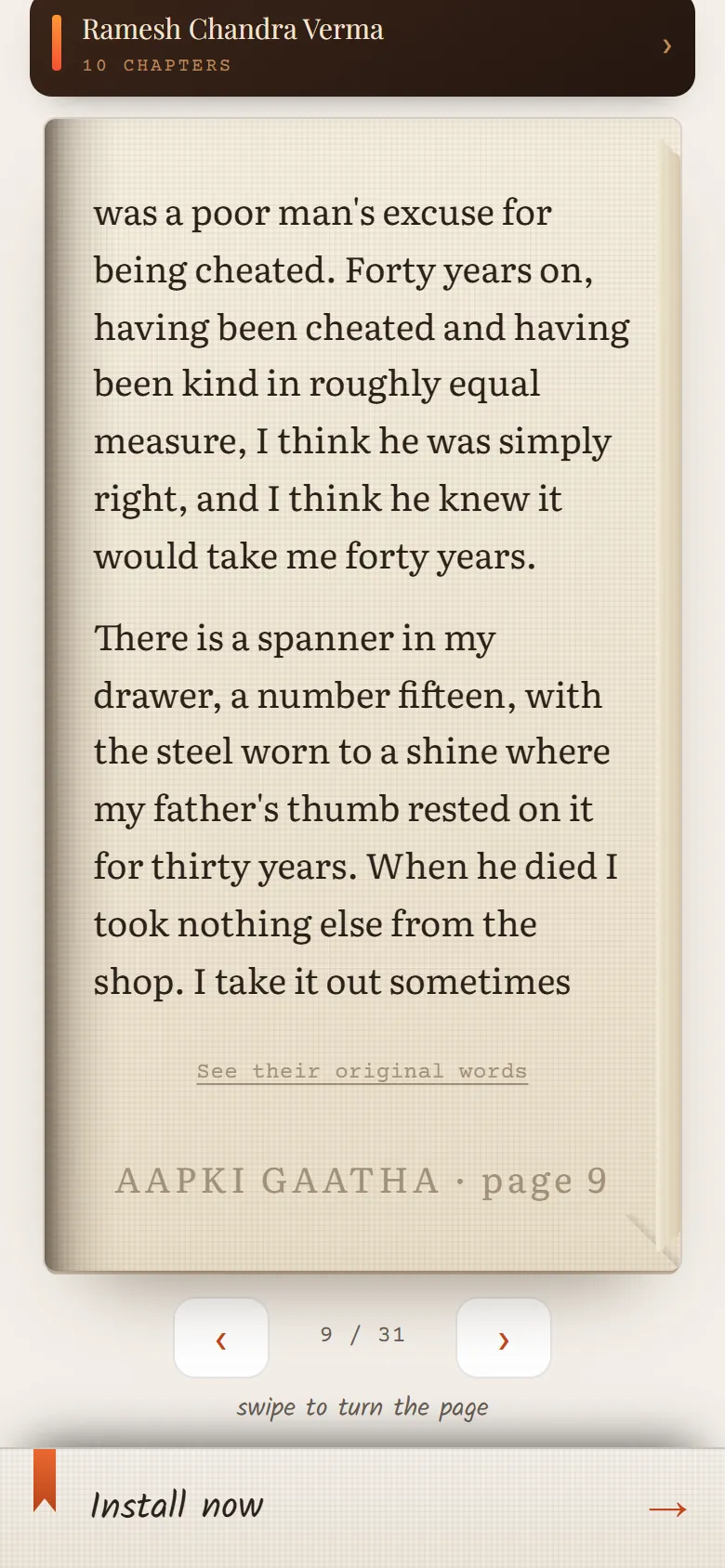
A page of the book on a phone, with the page-turn buttons underneath
३

One person starts it, the whole family keeps it

parivaar saath, kitaab saath

The family’s chats: the room for everyone, then one line per person, each named the way the family names them
४

Leave something for later

waqt ke liye

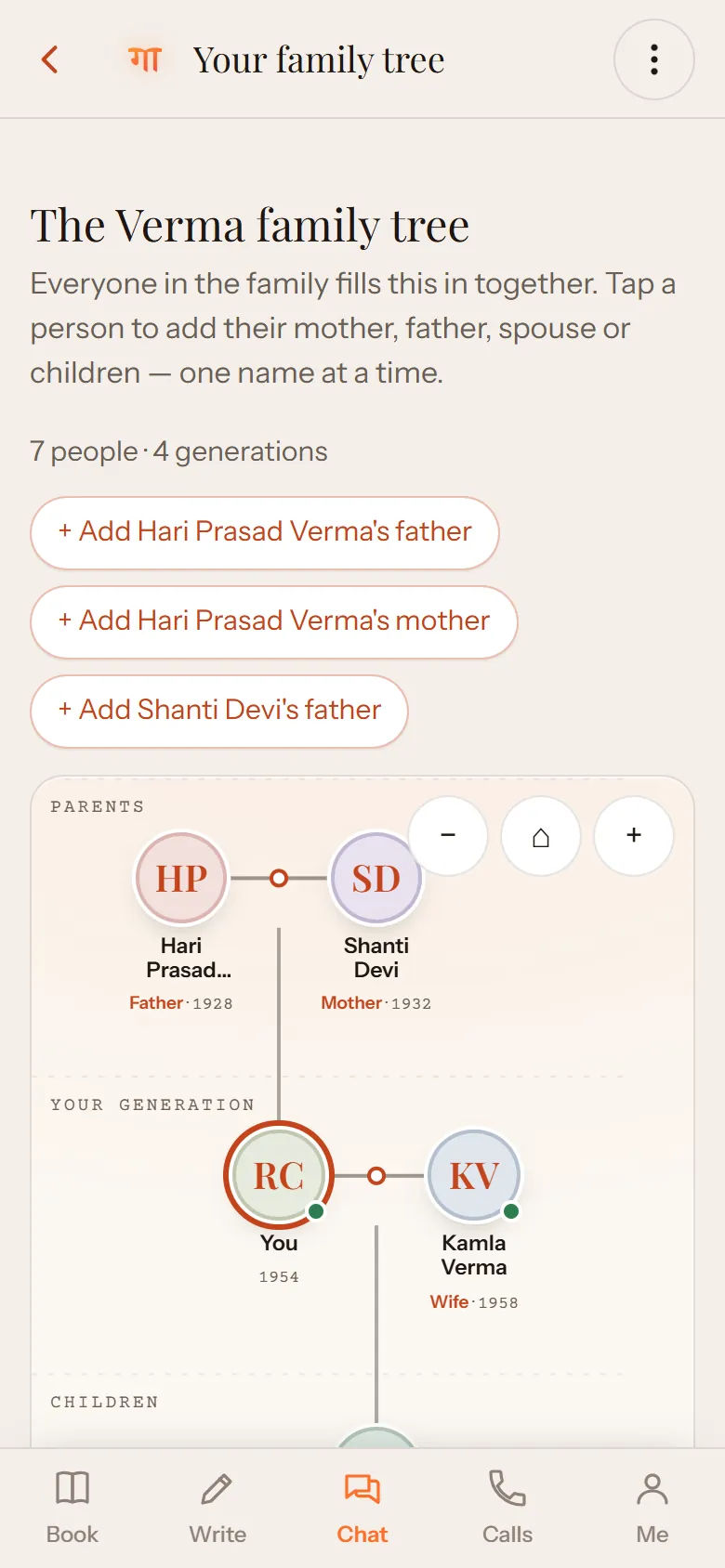
The family tree: three generations, every relationship worded from where you stand
५

Yours, and only as open as you say

faisla aapka

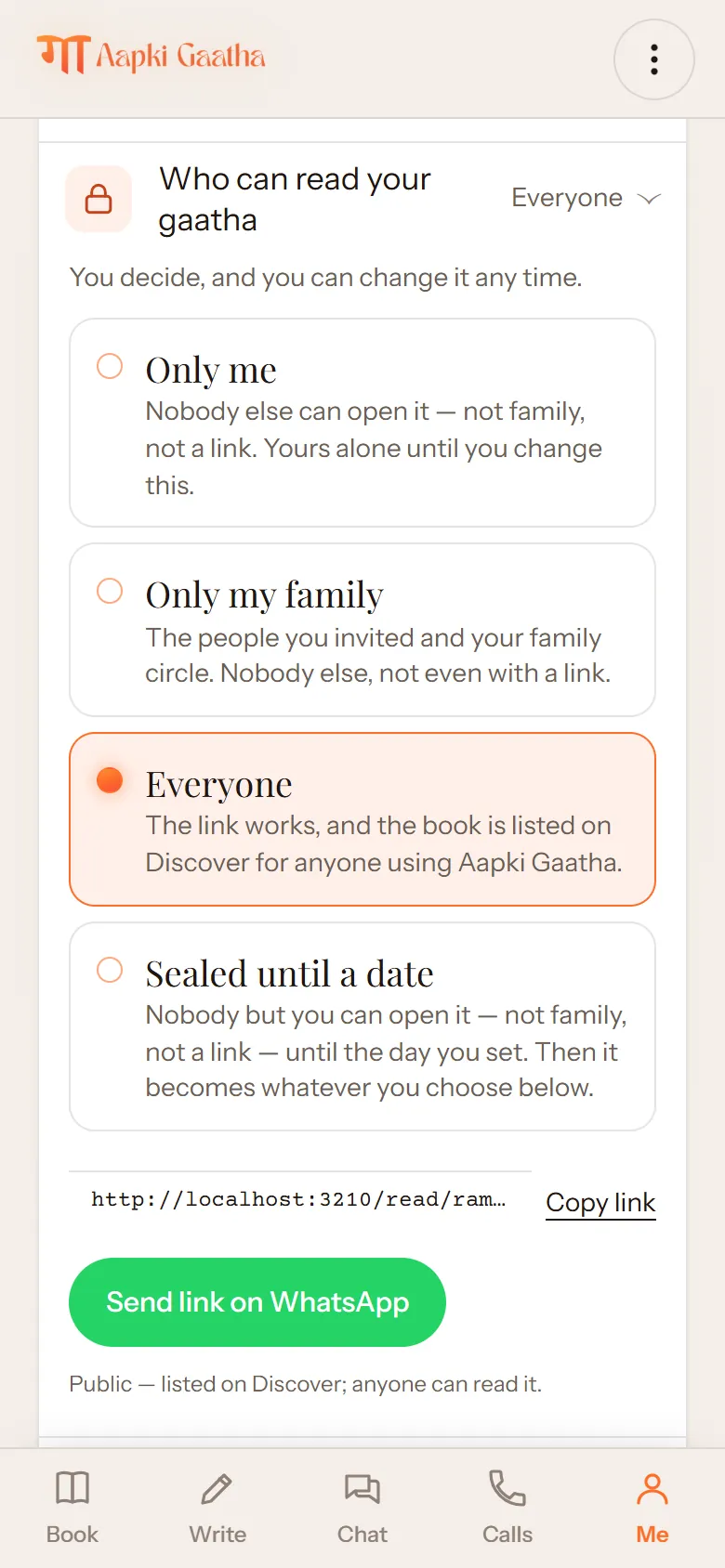
The privacy screen: only me, only my family, everyone, or sealed until a date

Stories

Pages that already exist.

Chapter 1 · 2026

Behind the tehsil office

I was born in a two-room house behind the tehsil office in Gorakhpur, on a night my mother swore the electricity failed twice, so the midwife worked by lantern light. There is no certificate of it, only her telling, and she told it the same way for fifty years. My father repaired cycles. He could true a wheel by sound alone, spinning it with one finger and listening for the spoke that sang wrong.

A neem tree stood in the courtyard, and in summer the whole family carried their cots out and slept beneath it, counting the same stars every night. My first memory is a sound and a smell arriving together: the hand pump creaking at dawn as my mother filled the brass pots, and the kerosene stove catching with its small blue cough. Even now, when I pass a stove like that, I am four years old for a moment.

My mother cooked, always, and on Sundays she made litti chokha over dung-cake fire so that the whole lane knew what the Vermas were eating. But if you ask what I loved most, it was her aloo ka parantha with white butter from the dairy near the station, the butter going into the cracks before I could catch it. We did not have much. I never once felt hungry, which I have since learned is a different thing, and I only understood the difference when I had children of my own.

AAPKI GAATHA · page 1

Chapter 2 · 2026

The year I built a bicycle

We had no toys, so at eleven I built a bicycle. The frame came from one wreck behind the shop and the wheels from two others, which is why it always pulled a little to the left, as though it wanted the river. It took me four months. When it was finished my father said nothing at all. He crouched, squeezed the brakes twice, straightened, and said one word: go. I rode eleven kilometres to the Rapti and came home after dark and was beaten for it. I have never owned anything since that felt so much like mine.

Holi, without question, because it was the one day in the year my father shut the shop. He came home with his hands still smelling of oil and let us cover his face in colour, laughing in a way he did not laugh on the other three hundred and sixty-four days. One year I reached into the wrong tin and smeared my brother's cheek with axle grease instead of gulal. My mother scrubbed him for an hour by the pump while he howled. He is seventy now and tells it at every wedding, and it gets worse each time.

AAPKI GAATHA · page 2

Chapter 3 · 2026

Fix it first

My father taught me that a man's cycle is his livelihood, and that a rickshaw puller with a broken wheel has a family who will not eat that night. So you fix it first and take the money afterwards. Often the afterwards never came. He would shrug and say the account was being kept somewhere else. I thought that was a poor man's excuse for being cheated. Forty years on, having been cheated and having been kind in roughly equal measure, I think he was simply right, and I think he knew it would take me forty years.

There is a spanner in my drawer, a number fifteen, with the steel worn to a shine where my father's thumb rested on it for thirty years. When he died I took nothing else from the shop. I take it out sometimes and fit my thumb into the hollow his thumb made, and for a moment the two of us are holding the same tool.

AAPKI GAATHA · page 3

Chapter 4 · 2026

Fourteen

My first job was not a job at all. I was fourteen when my father put his hand into a moving chain and could not work for three months, so I opened the shop myself at six every morning and sat there. For a week nobody came. Who hands his livelihood to a boy. Then Sharma ji's rickshaw threw its chain outside our door at seven in the morning and there was nowhere else open in that hour. I fixed it in twenty minutes with my heart going like a bird. The next morning there were three cycles waiting, and one of them had come from the next mohalla.

That same year, and not on the day I first earned. It was the evening I told my mother there was enough for the month, and watched her decide to believe me. She did not check. She simply put the tin back on the shelf and asked what I wanted to eat. I was fourteen. Once someone has believed you like that you cannot go back to being a child, however much you might later want to.

AAPKI GAATHA · page 4

Chapter 5 · 2026

Nine months of dust

In 1983 they opened Station Road for a drain and left it open for nine months, and a cycle shop on a road nobody can reach is a room full of tools. We ate rice and salt on more days than I care to count, and I am not ashamed to say so. Kamla sold the gold bangles her mother had given her and never told me; I learned it from the jeweller years afterwards, when I had gone in about something else entirely and he said, casually, that he still had them. In 1991, the year the shop finally did well, I went and bought them back. She wore them to Neha's convocation and said nothing about it. Neither did I. We are not a family that says such things out loud.

In those nine months it was the rickshaw pullers who carried us, and they did it without once letting me see it as charity. They began coming the long way round, through the mandi, twenty minutes out of their own earning day, so that their cycles were repaired at my shop and not at the one on the open road. Not one man ever said that he was helping me. They complained about the price, as always. That was how I knew.

AAPKI GAATHA · page 5

1 / 10

The book itself — the same reader that opens every gaatha. Scroll to turn the page, or tap the arrows and read on.

“There is a spanner in my drawer, a number fifteen, with the steel worn to a shine where my father’s thumb rested on it for thirty years.”
Ramesh Chandra Verma · chapter three
“Kamla sold the gold bangles her mother had given her and never told me; I learned it from the jeweller years afterwards, when I had gone in about something else entirely and he said, casually, that he still had them.”
Ramesh Chandra Verma · chapter five
“On the day I shut the shop for the last time the rickshaw pullers of Station Road came together, forty of them, men whose wheels I had straightened for thirty years, and put a shawl around my shoulders.”
Ramesh Chandra Verma · chapter nine

Read his whole gaatha →

Ramesh Chandra Verma is a demonstration book — written to show what a finished gaatha looks like, and labelled as one on its own page. Every other book on Aapki Gaatha belongs to the family that spoke it, and only they decide who may read it.

Try one question

What did your mother's kitchen smell like?

Day 1AAPKI GAATHA · a page in the making

yahan koi galti nahi hoti — bas yaadein hoti hain

Start my book

Day 1

What did your mother's kitchen smell like?

Your page is waiting for your words…

AAPKI GAATHA · page 1

Questions

Things families ask us

Do I need to know how to write?

No. Speak your answer and it is written for you. Every word stays editable, and the recording is kept as it is.

Which languages?

Hindi and English fully. Twelve more Indian languages are in beta, and the voice is kept in whatever language you speak.

Who can read my book?

Nobody but you, until you decide. Then your family, anyone with the link, everyone — or sealed until a date you choose.

Can I make one for my mother or father?

Yes. Gift it: you start the book, they get a link on WhatsApp, and they simply answer. You both keep it.

What happens to the voice recordings?

They are kept as recordings, forever, beside the page they became. Nothing is ever overwritten.

Is Ramesh Chandra Verma a real person?

No. His book is a demonstration, written so that a visitor has something complete to read before starting their own, and the app says so at the top of it. Nothing on this page is quoted from a customer’s book: those belong to the families who made them.

shuruaat sirf ek naam se hoti hai

Begin today. One question. Your voice.